Jumat, 10 Juli 2009

An Opportunity With A Tight Budget

Good Day Mr Dunbar!

I'm seeking answers & asking for your help with food cost & menu engineering.

Info in hand: I put up my own cafeteria inside a factory; catering to 80+ people. I'm a BS Hotel& Restaurant Mgt graduate - 2005; can not remember much about Food Costing. The net only gives guides & lacks experience that's where I'll need your expertise sir.

They also allotted only 2 dollars for food allowance; the employee must eat at least 1 meal(breakfast,lunch or dinner) & 1 snack. How can I manage & even start w/ this.

Thank you in advance for the time & opportunity!

God Bless!

Gabo


If you are fully reimbursed for labor and all other expenses (including profit), it would be possible to offer a menu with lots of eggs, poultry, starches, seasonal vegetables and tea given the allotment. You won't be able to offer any higher cost protein items. The labor issue is key. You'll need to make soups and other labor intensive menu items to meet your goals.

Try to focus on quality as much as possible. Keep accurate records.

After 90 days, ask for a meeting with your client. Try to negotiate a change order. If they enjoy your menu and find you honest and fair, you may be able to suggest some other higher cost ingredients.

What Should Our Bar Cost Be?

Hi Joe

What would you say my expectations for beverage cogs should be in a private club, not a member owned club?

Beer

Wine

Liquor

Thanks for your input, I’m trying to do an analysis and I need some solid guidelines on what it should be.

Sharon│Controller


Sharon,
A well controlled bar is a great source of profit. Many bar operators are out of control and the result over time is unnecessary selling price increases. Alcoholic beverages are highly regulated and the customers order specific brands. This makes for relatively stable costs (usually change quarterly) and no specification issues.
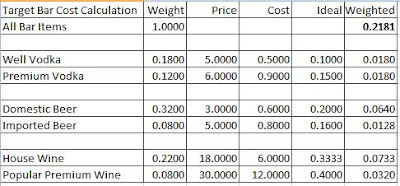


[Feel free to download this simple tool on my Food Cost Control Library site.]

I like to track a simple weighted average figure rather than a hypothetical benchmark. Depending on the level of service, occupancy costs and other factors beyond the cost of alcoholic beverages, your selling price will vary. Sales need to cover all costs and provide a profit (even if your goal is break even at the club, you should budget for risk and cover slightly more than your costs).

Using a weighted average, you should track a handful of key bar items: well vodka drink, premium vodka drink, domestic beer, imported (or micro-brew) beer, house wine and premium wine. Weight each item by the respective sales impact. Sales for all well pours for the well vodka, sales for all premium liquor for the premium vodka, sales for all domestic beers, sales for all premium beers, sales for all house wines and sales for all premium wines.

You simply enter the selling prices and cost of the alcoholic beverages. The Weight column should total 100% or use your total sales. The Ideal column equals the cost divided by the selling price. The Weighted column will supply the answer to your question. This column weights each Ideal figure based on the share of sales for the category.

Feel free to add more categories. The weights should always equal 100% of sales. Guard against going into too much detail. We are not trying to solve every issue with the formula. You will find the current bar cost percentage is higher than the formula result. Resist requests to complicate the formula. Leave all non-alcoholic items out of the pouring cost.

I have found numerous bar operations with major problems (theft, over-pouring, wasting draft beer, lost revenue, etc.) splitting the atom over lemon wedges, olives, and wine sent to the kitchen. Create a separate line item to track the non-alcoholic beverage activity and kitchen wine, liquor and beer.

Accounting Gets Closer To The Kitchen

This month, I noticed an urgency in 3 restaurant chains which would be out of the question in the past. Top level financial officers have made the dive into inventory control including batch recipe models for work in progress inventory. Calling late at night, I found the CFO of a 35 unit chain in the office working feverishly to get the new database deployed. She was working on recipe costing and linking her recipes to the POS system.

Years ago, restaurant companies needed to be shoved into software systems to get better a handle on their cost of sales. Now, these solutions are ubiquitous. POS vendors throw them in for free to sweeten an offer. Solutions exist in every price range.

I spoke with the Executive Chef of a 6 unit group here in the DC Metro area. He was working on a solution with his brother who works in the accounting department. Each of their concepts has a unique menu and they have finished the first test. Results have exceeded their expectations. The actual food cost has now come down to less than 1% above ideal.

Recessions often force corporate staff to wear different hats.

As these financial people work closely with the chefs, purchasing agents and other key operations people, the reports have to improve. Communications are more focused and everyone has a feel for their counterpart's unique issues.
Related Posts Plugin for WordPress, Blogger...