Rabu, 08 Juli 2009
Food Cost Control Alliance
I would like to introduce my colleague from Australia, Paul Clarke, who will be posting here on the Food Cost Control Blog. Paul has his own blog, Food Margin which offers a "dialog on food operation management" with an impressive start. Food Margin is one month old today.
Selasa, 07 Juli 2009
Recipe Costing Technique - Plate Cost
Hi Joe.
I hope im posting this in the correct blog.
In order to cover our waste, free bread, staff food, and complimentary items we are planning to add a plate cost to our new recipes to cover these costs. We understand that this will push our selling prices up. My question is as follows:
Do we add the plate cost to the recipe or do we simply raise the selling price by the respective plate cost?
Ray
From a strategic viewpoint, there are many options for menu price revisions. The correct overall solution would need to take other factors into consideration.
I prefer to add the plate cost as a fixed number(vs. a percentage)for each entree. This is a preference not an absolute. Some operations will be better off taking a different approach.
The fixed dollar method will also cover your costs regardless of the entree selling price. You'll receive the same cost coverage whether the selling price is $9.99 or $29.99. This is especially attractive now as consumers are choosing lower priced menu items.
Generally, any amount you add to a selling price as a fixed dollar amount is 100% variable from a cost accounting perspective. As you sell units (in our case entrees), the revenue (and variable cost coverage ) are in sync making your break even point more predictable.
Many companies provide complimentary items and do not provide for these costs in their selling prices. With consumers looking for value, you need to consider competitive threats when you evaluate any price increase decision.
Rabu, 01 Juli 2009
Basic Recipe Costing - Part1
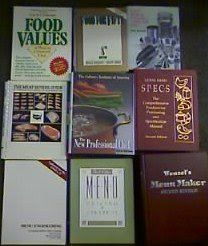
You may have lots of cookbooks, proprietary recipes, books with food yield statistics, market data, shopping lists, inventory count sheets, supplier quotes, product mix reports, quarterly tracking reports and other documents. A professional recipe model should be designed to integrate all of this useful information. The person working on this project needs to wear many hats: purchasing agent, steward, prep cook, line cook, and chef.
Rather than using a cookbook approach, start with your shopping lists. Use your shopping lists to create a spreadsheet with all your ingredients. Make columns for the name, category, primary supplier, purchase unit, storage area and storage unit.
Since the unit you purchase is used on orders, this is our starting point. It's helpful to know your alternate sources for each ingredient. You may want to categorize each item by the storage method. For example, frozen, refrigerated, dry bulk, canned goods, frozen goods, baked goods, etc. Feel free to add these columns. Its impossible to get too much information for your ingredient list.
[We'll eventually need to know the usage units for each ingredient and portion information. This will be discussed in Part2 (later this month).]
Once the list begins to come together, envision the flow for each item from loading dock to the table. Most items are purchased by the case and are stored as purchased. Some items are immediately transformed into other items through fabrication. Visualize the process of moving from the purchased unit of measure to the storage unit of measure first.
You may simply remove six #10 cans from a case and place the cans in a rack. The purchase unit is case and the storage unit is a #10 can. Focus on the storage unit and the divisor (6 in our example). Breaking down every item you purchase into logical storage units is one of the most important steps in creating a professional recipe costing model.
Each #10 can is valued at 1/6 of the case cost. Don't worry about the actual cost of each can. Focus on the number of storage units in each purchase unit.
Our work will eventually involve many calculations using units of measure, various blends, yield formulas, conversions, reciprocals and standard portion data. The simple exercise of developing a purchase unit to storage unit model is the ideal starting point. Once you complete this exercise, future conversion work will be more intuitive.
Rather than using a cookbook approach, start with your shopping lists. Use your shopping lists to create a spreadsheet with all your ingredients. Make columns for the name, category, primary supplier, purchase unit, storage area and storage unit.

Since the unit you purchase is used on orders, this is our starting point. It's helpful to know your alternate sources for each ingredient. You may want to categorize each item by the storage method. For example, frozen, refrigerated, dry bulk, canned goods, frozen goods, baked goods, etc. Feel free to add these columns. Its impossible to get too much information for your ingredient list.
[We'll eventually need to know the usage units for each ingredient and portion information. This will be discussed in Part2 (later this month).]
Once the list begins to come together, envision the flow for each item from loading dock to the table. Most items are purchased by the case and are stored as purchased. Some items are immediately transformed into other items through fabrication. Visualize the process of moving from the purchased unit of measure to the storage unit of measure first.
You may simply remove six #10 cans from a case and place the cans in a rack. The purchase unit is case and the storage unit is a #10 can. Focus on the storage unit and the divisor (6 in our example). Breaking down every item you purchase into logical storage units is one of the most important steps in creating a professional recipe costing model.
Each #10 can is valued at 1/6 of the case cost. Don't worry about the actual cost of each can. Focus on the number of storage units in each purchase unit.
Our work will eventually involve many calculations using units of measure, various blends, yield formulas, conversions, reciprocals and standard portion data. The simple exercise of developing a purchase unit to storage unit model is the ideal starting point. Once you complete this exercise, future conversion work will be more intuitive.
Langganan:
Postingan (Atom)
